

The Algorithm Behind Your $90 Roast
I didn't smoke my Thanksgiving roast. Here's why.

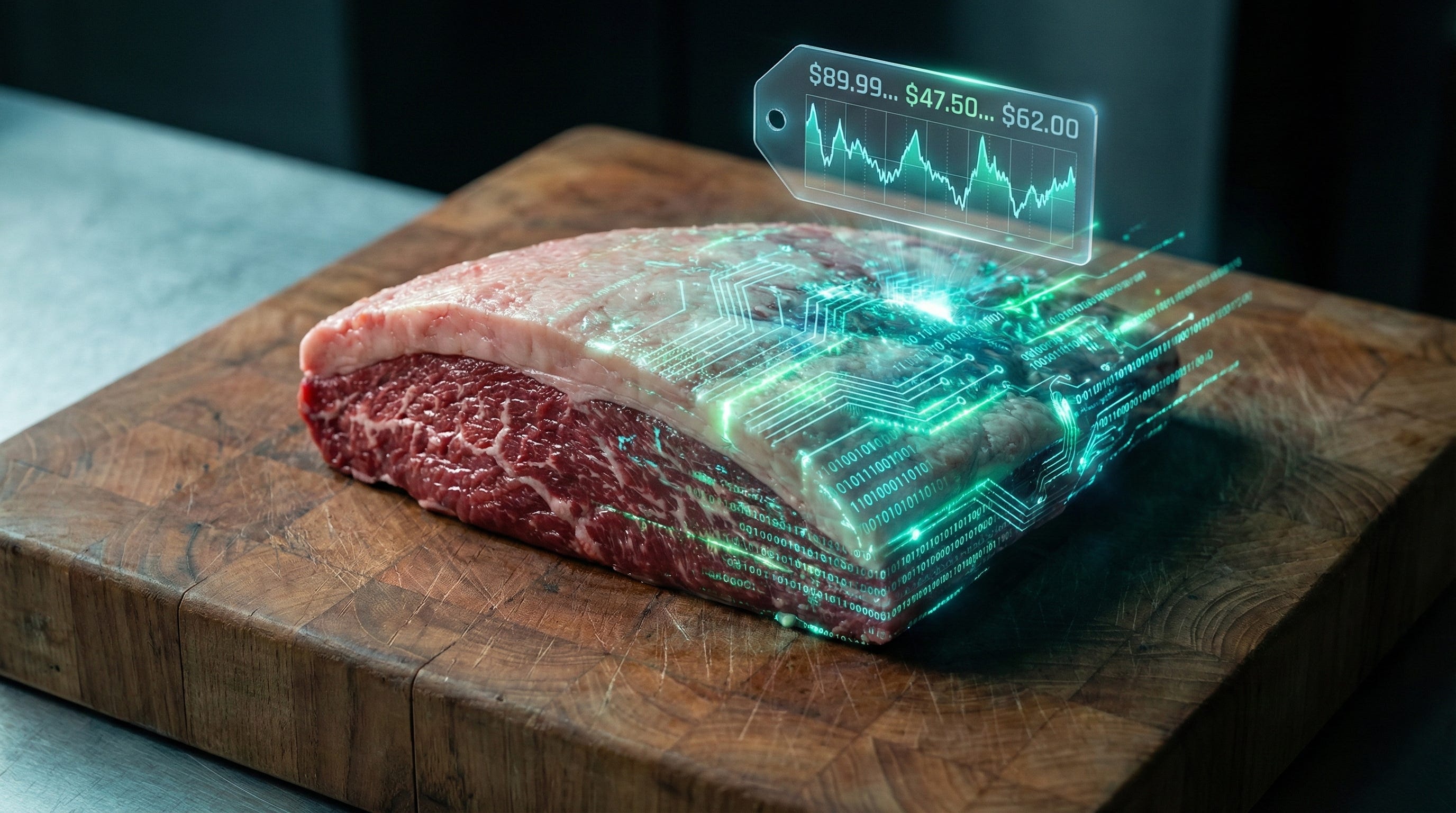
TL;DR: That $90 holiday roast wasn't "inflation." It was an algorithm testing how much you'd pay. Here's how the system works and what you can actually do about it.
Mid-November I replaced my smoker. New Pit Boss competition series. The first one had issues, I had to return it, then wait for a replacement. Finally ready to go.
A few days before Thanksgiving I headed to Costco. Excited. New smoker sitting at home, waiting to be broken in. I wanted beef. A small roast, tri-tip or picanha, something I could take my time with.
I don’t usually check prices. But I did that day.
A 5-pound picanha roast. Close to $90.
I walked away.
The smoker sat in my garage, unused. Thanksgiving came and went.
A few weeks later my buddy texts me. Same cut, same store, now around $47.
That’s not “prices went down.” Maybe it was just a seasonal markdown. But the tech already exists to do exactly that kind of holiday extraction, and vendors brag about using it on holiday staples.
There’s No Guy in a Back Office
Most people imagine some manager in the back room with a pricing gun, making calls based on gut feel and yesterday’s sales numbers.
That’s not how it works anymore. Not even close.
Modern grocery pricing runs on sophisticated software platforms that make airline pricing look simple. These aren’t spreadsheets. They’re AI-powered price optimization engines that model your behavior, predict your breaking point, and extract the maximum amount you’ll pay before you walk away.
And they’re everywhere. Kroger, Walmart, Albertsons, Instacart. The major chains are all using some version of this.
The Tech Stack Behind the Bullshit
Let me break down what’s actually happening under the hood. Because this isn’t “supply and demand.” This is algorithmic extraction dressed up in business-school language.
The software:
Companies like Eversight (owned by Instacart), Revionics, RELEX, Clear Demand, and a dozen others sell price optimization platforms to grocery chains. These systems plug directly into point-of-sale data, inventory systems, loyalty programs, and external data feeds.
Here’s what they ingest:
Historical sales for every SKU. How fast does this picanha sell at $50? At $70? At $90?
Inventory levels and expiration dates. Perishables get special treatment.
External signals: holidays, local events, weather, competitor prices scraped from ads and websites.
Your purchase history, if you use a loyalty card or shop online.
Then they model price elasticity. That’s the fancy term for “how much can we raise this before people stop buying it?” The system runs thousands of what-if scenarios to find the price that maximizes total profit. Not volume. Not fairness. Margin.
The output: specific price recommendations by item, by store, by day. Sometimes by hour.
The infrastructure:
With electronic shelf labels rolling out, prices can change instantly. Walmart is installing ESLs in 2,300 stores by 2026, covering over 120,000 items per store. What used to take two days to update now takes minutes.
Sources report these systems can adjust prices multiple times per hour. The tech makes it possible for prices to change while you’re in the store, even if retailers aren’t openly doing that yet.
The language they use:
Eversight’s marketing describes stores as “powerful learning labs” where they “test untried prices with real shoppers in small experiments that continuously run at scale.”
Read that again. You’re not a customer. You’re a test subject in a continuous pricing experiment you never agreed to.
Clear Demand talks about “finding the optimal price point” and “unlocking pricing power.” Vendors promise to help retailers “optimize each product at its maximum profitable point.”
Maximum profitable point. That’s the whole game. Not the fair price. Not the competitive price. The maximum they can charge before you walk away.
The Instacart Experiments
Consumer Reports ran an investigation in December 2025. They partnered with Groundwork Collaborative and More Perfect Union to dig into Instacart’s pricing.
What they found was damning.
Instacart was running AI-enabled pricing experiments on shoppers without telling them. Same item. Same store. Different prices for different customers on their online platform. Up to 23% higher for some people.
Every single volunteer in their test encountered at least one experiment. Nobody knew they were in a pricing test.
Over a year, that could mean $1,200 more for a typical family. For the same groceries. From the same store. Just because the algorithm decided you’d pay it.
After the investigation went viral, Instacart shut down that specific program. But here’s the thing: Instacart owns Eversight, the same company selling “pricing experimentation” tools to every other grocery chain in America. And Instacart told Consumer Reports they’ll still allow partners to run promotional tests and discounts. They call it “industry standard.”
The infrastructure didn’t go away. The experiments just got rebranded.
Inside the Pricing Engine
Let me get more specific about what these systems actually do. Because “price optimization” sounds almost reasonable until you see how the sausage gets made.
What they ingest:
These platforms pull in everything. Your loyalty card history. Your basket composition over time. How often you buy, what time of day, and what you buy together. They scrape competitor prices from websites and weekly ads. They pull in weather data, local event schedules, and even school calendars.
Revionics brags about “deeply experienced AI models” that “crunch massive amounts of data to understand how shoppers will react to different combinations of price increases and decreases.”
React. Not prefer. React. They’re modeling your tolerance, not your preferences.
Officially, vendors like Instacart say these tests use “randomly assigned” groups, not your age or income. But their own patents describe exactly those kinds of targeting knobs, grouping customers into “subpopulations” by age, gender, and household income. The tools are built to do it, even if the PR line is softer.
How elasticity testing works:
Every product has an elasticity curve. Raise the price 10% and volume drops X%. The system runs thousands of simulations to find the price where (price x volume) minus cost equals maximum profit.
But here’s the part they don’t advertise: they’re not just modeling. They’re testing. On you. In real time.
Eversight’s platform runs “small experiments that continuously run at scale.” That means some customers see $4.99 for Wheat Thins while others see $5.49. The system watches who buys, who doesn’t, and updates the model.
They also use tricks like “smart rounding,” a form of machine learning that tweaks prices ($4.99 vs. $5.09) to improve “price perception” while still increasing the amount you pay.
You’re not shopping. You’re participating in an A/B test you never agreed to.
How BOGOs and “member deals” are really designed:
That “Buy 1 Get 1 50% off” on cereal? That’s not a favor. That’s an experiment.
Vendors like Eversight literally sell “Offer Innovation” software that tests which BOGOs and member deals make you switch brands or add one more item to your cart. The system is testing: Does this offer increase basket size? Does it trigger brand switching? Does it bring you back sooner than your normal purchase cycle?
“Member prices” are the same game. You hand over your data. They use it to model your behavior. Then they show you offers calibrated to extract maximum value while keeping you loyal enough not to switch stores.
If it feels like a favor and requires your data, it’s an experiment.
The platforms call this “trip-builder logic.” The real test is whether that cereal BOGO gets you to add extra high-margin items you didn’t plan to buy.
Shrinkflation: The Other Scam
Price optimization isn’t the only game. There’s also shrinkflation. Same price, less product. Different scam, same result.
Purdue’s Consumer Food Insights survey found 77% of shoppers noticed shrinkflation in the past 30 days. Snacks are the worst: 78% of people who noticed shrinkflation saw it in snack foods first.
It works because most people check total price, not unit price. The systems know this. The same logic that hunts for maximum profitable prices shows up in package sizes too, even if the shrinkflation research doesn’t spell out exactly which software is pulling the levers.
Why This Pisses Me Off
Look, I work in enterprise tech. I understand optimization. I understand margins. I’m not naive about how businesses work.
But there’s a line. And this crosses it.
It’s not just that groceries are expensive. It’s that you’re being turned into test data without your knowledge or consent.
Every time you scan your loyalty card, you’re feeding a model designed to extract more from you. Every “personalized offer” is a probe testing your price sensitivity. Every checkout is a data point refining their ability to charge you more next time.
The vendors don’t hide this. Eversight literally calls stores “powerful learning labs.” You’re the lab rat in these online experiments.
Right now, the proven price discrimination is happening on platforms like Instacart, not physical shelves. Instacart explicitly told Consumer Reports their experiments are “not currently integrated” with their physical shelf tech. But ESLs are the infrastructure that could bring similar tactics into the aisle. The capability is there. The intent is documented. It’s a matter of when, not if.
Groceries aren’t airline seats. You can skip a flight. You can’t skip dinner.
When these systems charge different people different prices online for the same box of cereal, that’s not “personalization.” That’s price discrimination. When they crank prices during holidays because the model says you’ll pay it, that’s not “dynamic pricing.” That’s gouging.
The FTC calls it “surveillance pricing.” Using detailed behavioral data to find the maximum each person will pay.
The vendors call it “unlocking pricing power” and “maximizing profitable price points.”
I call it what it is: algorithmic greed dressed up in machine learning.
What You Can Actually Do
I’m not going to pretend there’s a magic fix. The system is designed to make fighting back hard. But there are things that actually help:
Check unit price, not sticker price. This is the single best defense against shrinkflation. Train yourself to look at price per ounce, not the number on the tag. Every store is required to display it.
Buy off-cycle. Holiday meat prices are algorithmic peaks. That $90 picanha? It was $47 three weeks later. The demand signal passed. The algorithm relaxed. Time your big purchases outside the obvious windows.
Compare channels. The same basket in-store versus online can have completely different prices. The Instacart investigation showed online convenience layers add their own pricing games on top.
Shop in person when you can. Right now, the documented individualized pricing experiments are happening online. Shopping in person, paying cash or card without loyalty programs, is currently the safest way to avoid being sorted into a pricing cohort.
Complain loudly. Public pressure works. Instacart killed its specific pricing experiments after the investigation went viral. Brands respond to bad press faster than they respond to anything else. Leave reviews. Tweet at them. Make noise.
The Bigger Picture
This isn’t just about groceries. The same optimization logic is spreading to insurance, hiring, lending, and healthcare. Anywhere there’s a transaction and enough data to model your willingness to pay.
Groceries just happen to be where most people feel it first. Because you can’t opt out of food.
That $90 roast wasn’t a mistake. It wasn’t supply chain issues. It wasn’t just “inflation.”
It was the system doing exactly what it was designed to do.
Try This Yourself
Pick one item you buy regularly. Check the unit price today. Write it down. Check it again in two weeks. Then again, after a holiday.
You’ll start to see the pattern.
And once you see it, you can’t unsee it.
What’s your version of the $90 roast? Hit reply and tell me. I’m collecting stories for Part 2.
AI Frankly: Honest talk about AI, including when it's being used against you.
Sources:
Consumer Reports: “Instacart’s AI Pricing May Be Inflating Your Grocery Bill” (December 2025)
Consumer Reports: “Instacart Stops AI Pricing Tests” (December 2025)
Purdue Consumer Food Insights Survey (October 2024)
Grocery Dive: “Walmart to bring electronic shelf labels to thousands of stores.”
Popular Science: “Digital price tags can change the cost of groceries.”
Eversight: “Dynamic Retail Pricing Software” (company marketing)
Clear Demand: “How AI Price Optimization Transforms Retail Pricing”
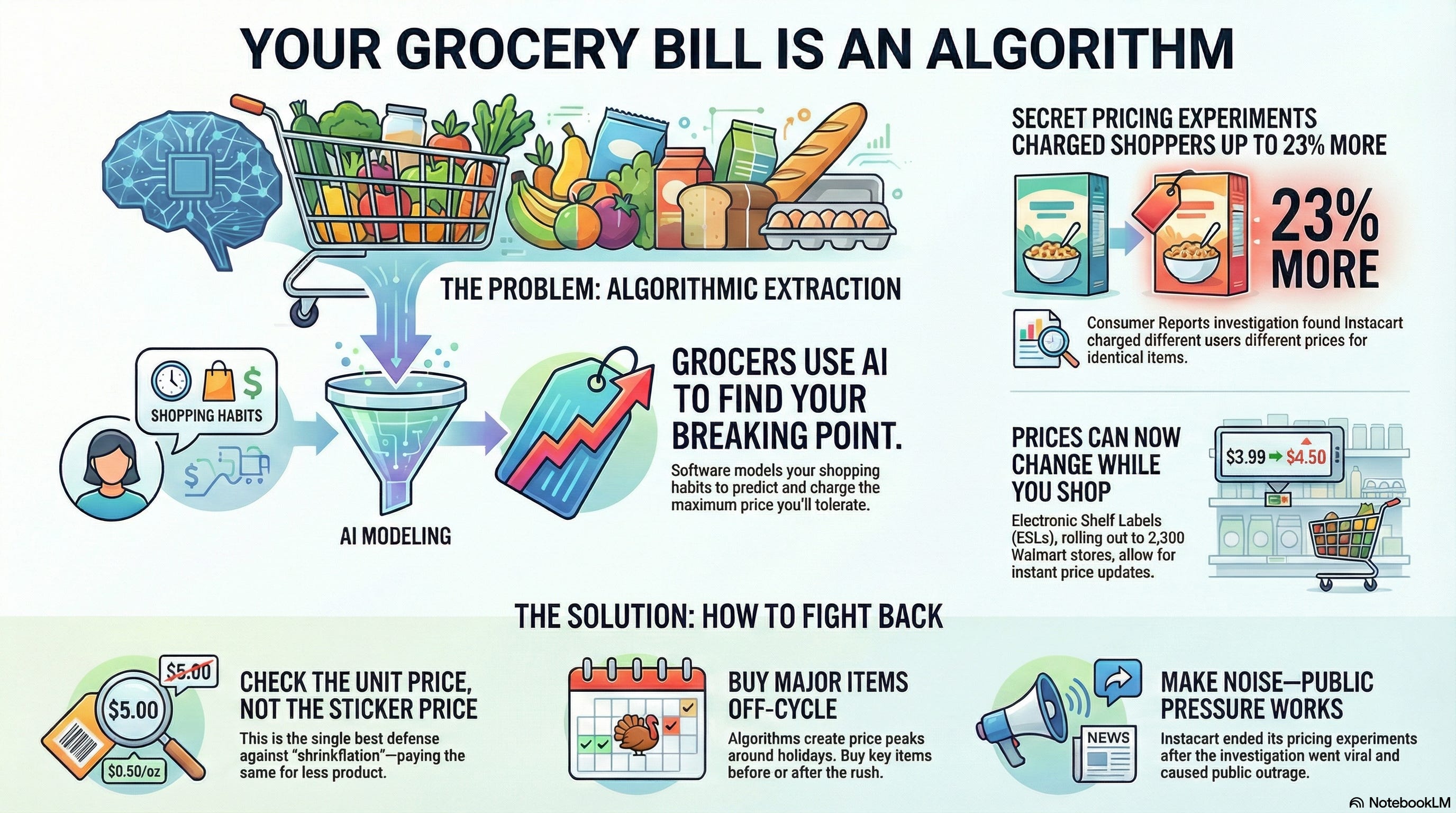
What the tech makes possible, and in some cases, what's already here.