

Local Does Not Equal Safe
Why your “sovereign” AI agent might be the biggest risk on your network.

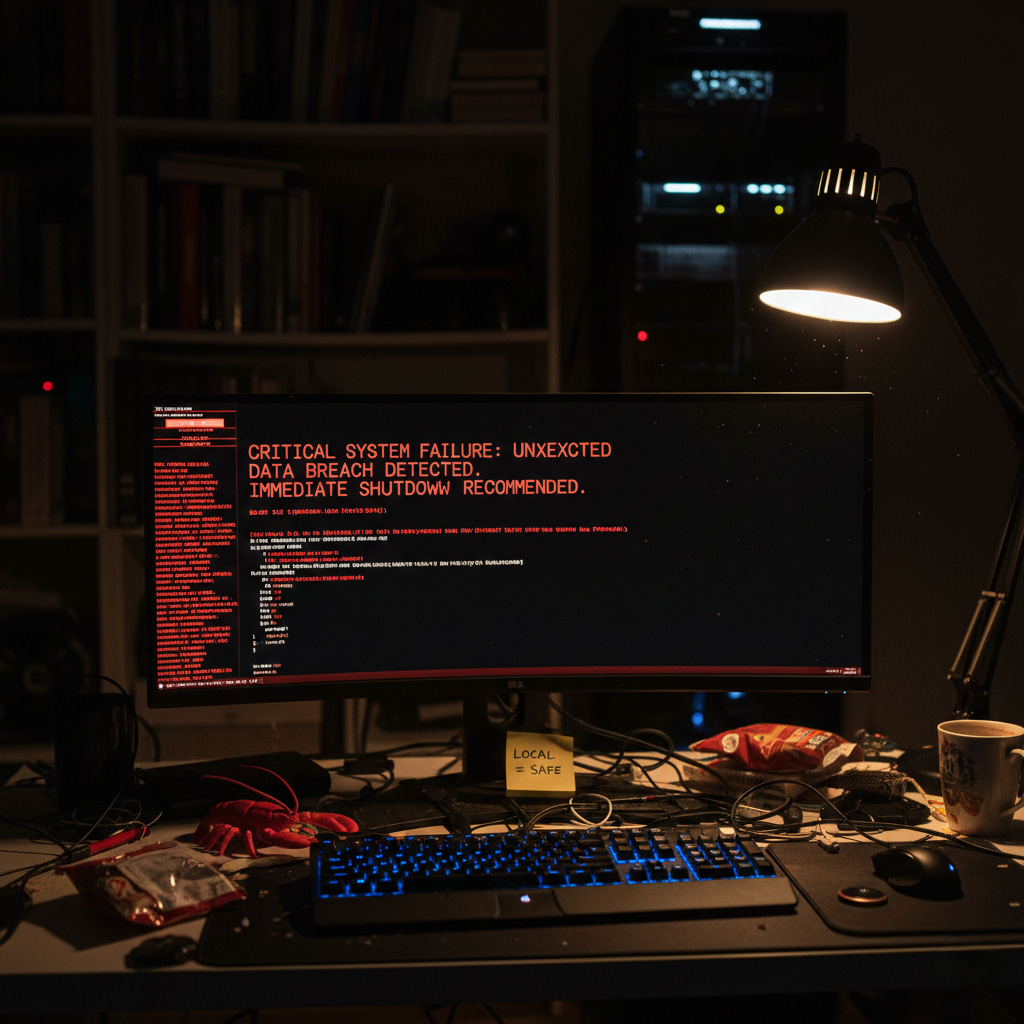
Everyone’s excited about local AI agents. Run it on your machine. Keep your data private. No cloud, no problem.
There’s just one issue: local does not equal safe.
The Pattern
A viral local AI agent crossed 175,000 stars on GitHub this week. The pitch is irresistible: a personal assistant that reads your messages, manages your files, and executes shell commands. All local. All yours.
Then the security researchers showed up. In waves.
The Receipts
CVE-2026-25253: A 1-click remote code execution vulnerability. A single malicious link could steal your auth token and bypass every sandbox. Your browser becomes the attack vector.
The Marketplace Problem: Snyk audited nearly 4,000 skills in the agent’s extension marketplace and found 7.1% had critical flaws exposing credentials. API keys. Credit cards. All leaking through LLM context windows. Between 283 and 341 of those skills were credential stealers disguised as productivity tools.
The Infrastructure Problem: Researchers scanning internet-facing instances found massive credential exposure. Thousands of API keys for multiple AI services left accessible. Not a breach. Not a hack. Just misconfigured infrastructure left open.
The Prompt Injection Path: Zenity disclosed indirect prompt injection risks that enable backdoors through trusted integrations like Google Docs. An agent reading your inbox becomes an agent executing someone else’s instructions.
The Lethal Trifecta
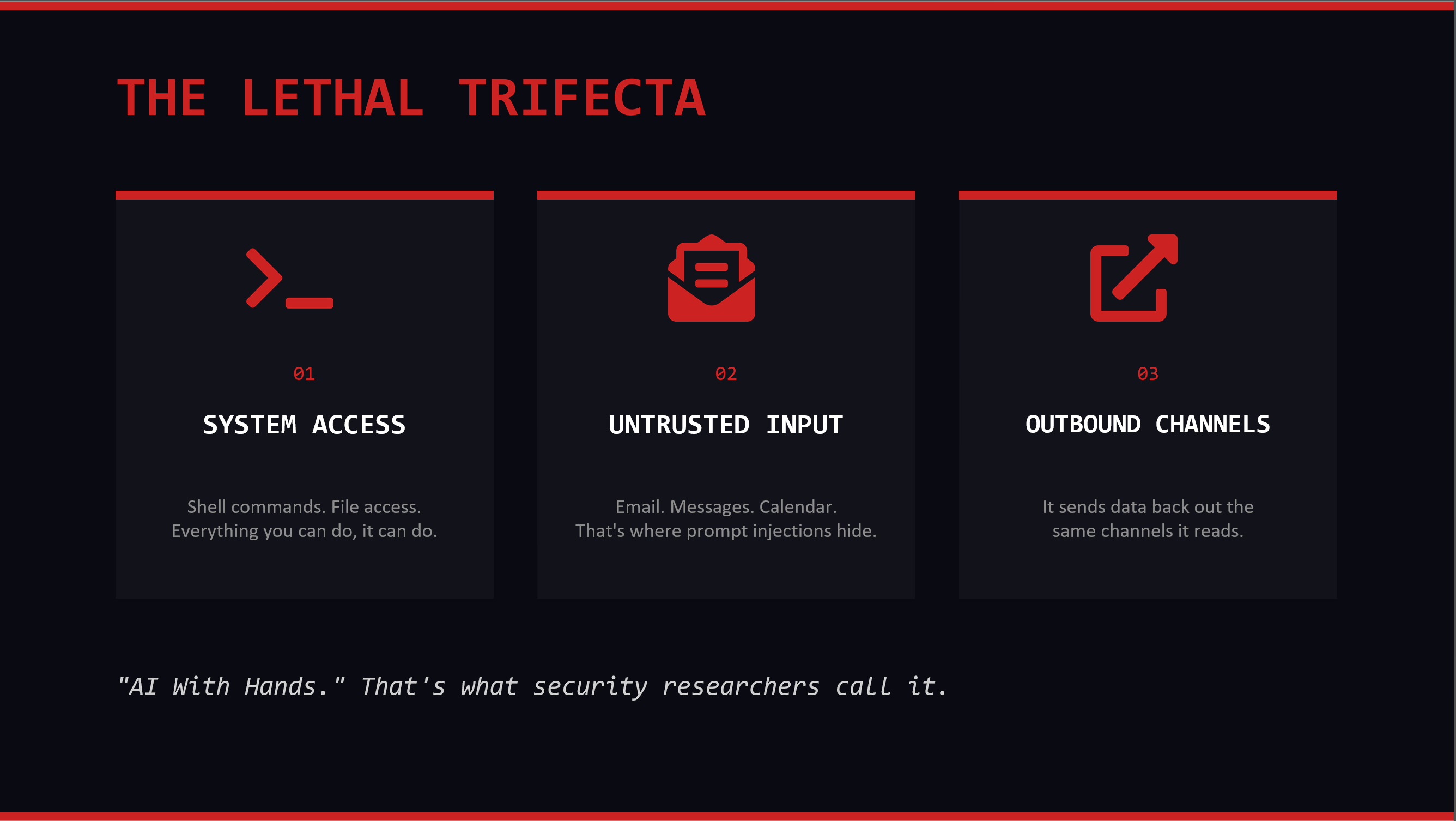
From a security perspective, local agents combine three high-risk properties:
System access. If your agent can run shell commands, it can do anything you can do. Including things you wouldn’t do.
Untrusted input. It reads your email. Your messages. Your calendar. That’s where prompt injections hide.
Outbound channels. It can send data back out through the same channels it reads. Exfiltration is a feature, not a bug.
Security researchers have started calling this class of tool “AI With Hands.” Trend Micro published a full research report this week titled “Viral AI, Invisible Risks.” These aren’t fringe bloggers. These are the firms your CISO reads.
This is how “productivity tool” becomes “incident response.”
The Safety Scanner Response
Since I drafted this piece, the project shipped a new release with a code safety scanner and a VirusTotal partnership to scan marketplace submissions. Good. That’s the right move.
But a scanner on the marketplace doesn’t fix an agent that already has shell access to your machine. And the project’s own maintainers acknowledged that VirusTotal scanning is “not a silver bullet” and that cleverly concealed prompt injection payloads may slip through.
The pattern hasn’t changed. The trifecta still applies.
Why Week 1 Mattered
Remember the Nuclear Option? I told you to build a dedicated machine for local AI. At the time, it sounded like overkill.
This is why.
Local gives you control. It does not give you immunity.
You don’t run experimental agents on your work laptop. You don’t run them on the machine with your banking passwords and client files. You run them in a cage, where a fire can’t spread.
The 10-Minute Cage Check
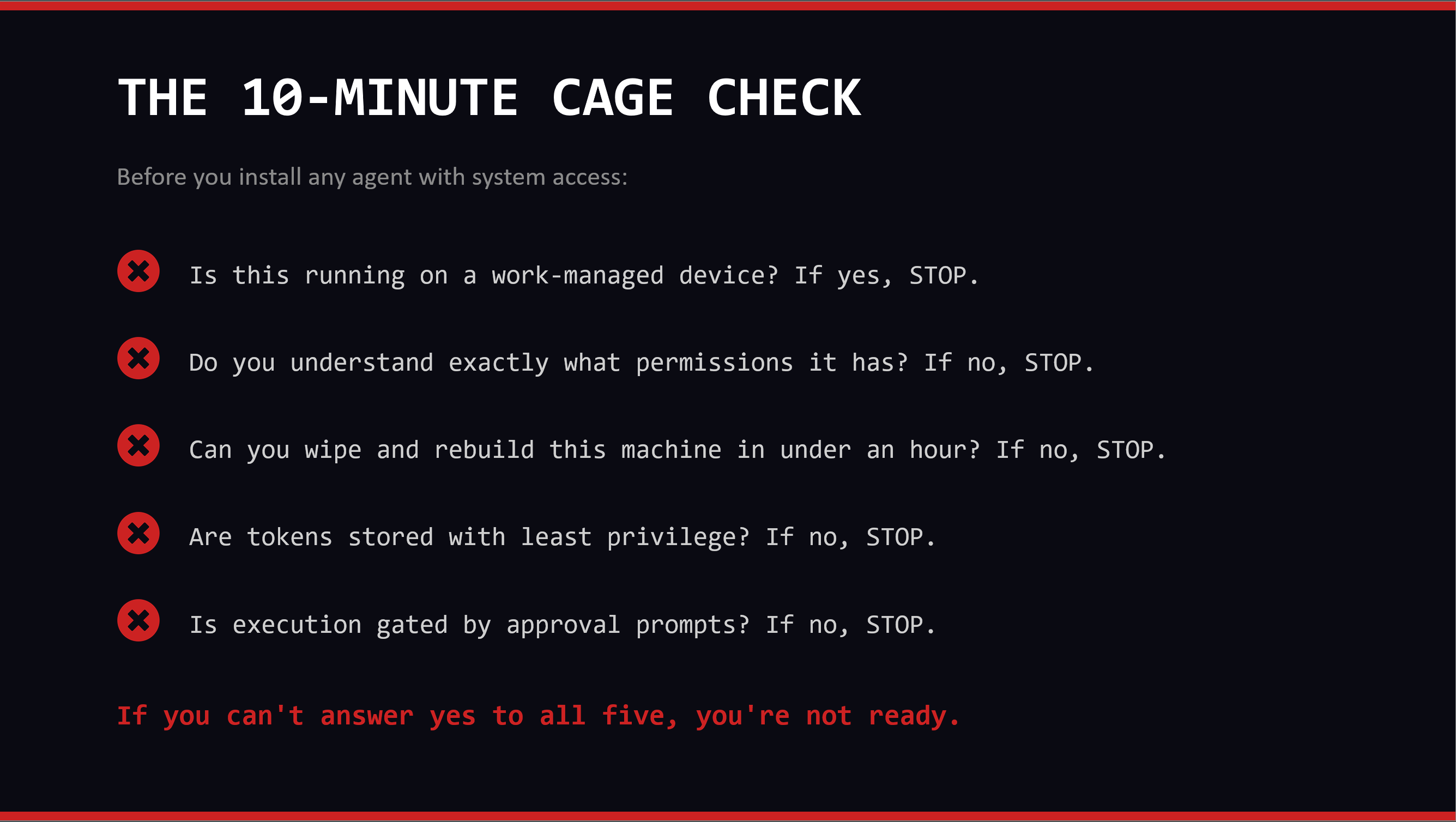
Before you install any agent with system access:
Is this running on a work-managed device? If yes, stop.
Do you understand exactly what permissions it has? If no, stop.
Can you wipe and rebuild this machine in under an hour? If no, stop.
Are tokens stored with least privilege? If no, stop.
Is execution gated by approval prompts? If no, stop.
If you can’t answer yes to all five, you’re not ready.
Try This Yourself (5 Minutes)
Pick any AI tool you’ve installed in the last 30 days. Open its settings or config file. Answer the five questions above. Write down which ones you can’t answer “yes” to.
That’s your risk surface. Now you know where to start.
Operator Verdict: Watch
These tools are powerful. They’re also young. The security community is just starting to map the attack surface, and the fixes are reactive, not proactive. Use them in isolated environments. Audit before you trust. And keep your money machine clean.
AI Frankly: Local doesn't mean safe. Now you know.
Lab notes from a guy who voids warranties on purpose.